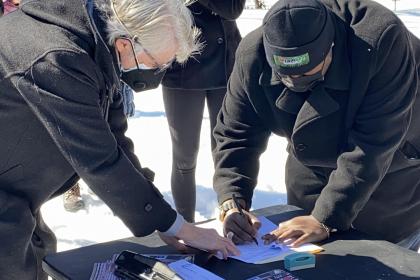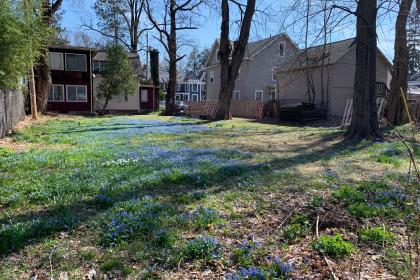

The George Washington Elementary School had a most successful season with 10 + garden plots that both the students and community enjoyed. Guided by Cindy and Thomas Muro, Kristin Wilson, Valerie Hannum, Julie Noble, the teachers, children and community, the members grew many different varieties of vegetables and flowers….and hosted many a composter! What a well rounded and educational garden we have in the city of Kingston. Rain barrels next…
If you would like to learn more about the GW School garden, visit their YAHOO group and become a member.
Thanks.
- Rebecca Martin

Flowers for all!

Working in the garden

Potatoes!

Gather around
Mohonk Preserve and The Kingston Land Trust Partner To Bring Venison To Families In Need
Mohonk Preserve and Kingston Land Trust partner to bring venison to families in need
Gardiner, New York, November 2009 – Thanks to a new collaboration between two land trusts, residents requiring food assistance will be in for a treat: fresh, wild venison. The source will be deer hunted across the Shawangunk Ridge, including at the Mohonk Preserve , Minnewaska State Park Preserve, and Sam’s Point Preserve. The Shawangunk Ridge Biodiversity Partnership’s deer management program allows regulated hunting to combat the negative ecological impacts of overbrowsing by deer. The Kingston Land Trust conceived of the program in response to growing economic stress, and in turn increasingly strained supplies at food pantries and soup kitchens.
“For residents of the region’s cities and villages who depend on food assistance to get by, this program offers high-quality meat that is not readily available,” said Arthur Zaczkiewicz, co-founder of the Kingston Land Trust. “Current economic conditions have strained households and local food programs, so the launch of this initiative comes at a critical time.”
The program will rely on voluntary donations of deer by hunters. For the first time, this year a refrigerated truck will be available on-call courtesy of the Cornell Cooperative Extension, to distribute venison to the Food Bank of the Hudson Valley .
“A properly managed hunting program can improve forests where deer overbrowsing has prevented tree regeneration and reduced the quality of habitat for birds and other wildlife, including deer,” says Ethan Pierce, Deer Management Program Coordinator for the Shawangunk Ridge Biodiversity Partnership. “Now we are pleased to also provide the opportunity for hunters to help families in need, and to support the use of a local, free-range, and widely available meat.”
Hunters interested in participating in the venison donation program, or any other aspect of hunting on the Shawangunk Ridge, as well as volunteers to help process donated deer, should contact Ethan Pierce, Deer Management Program Coordinator, at 845-255-5969 or epierce@mohonkpreserve.org. Please sign up for donation before harvesting a deer so we can arrange for timely pick-up.
Located in five Ulster County towns, the Mohonk Preserve is the largest member- and visitor-supported nature preserve in New York State . Managing nearly 7,000 acres of the Shawangunk Ridge, the Preserve works to protect the ridge and to inspire people to care for, enjoy, and explore the natural world. Visitors are welcome on Preserve lands and at the Visitor Center , which has exhibits, trails, and a gift shop. Preserve lands are open sunrise to sunset every day, and a current membership or day entry pass is required to access the lands. Admission to the Visitor Center is always free. For more information, visit www.mohonkpreserve.org or call (845) 255-0919.
# # #
Inspired by the recent ‘Leave It On The Lawn, Kingston!’ campaign, a resident recently sent along these photos to show their change in ways by mulching and composting leaves this fall season.
Thanks so much for sharing and setting a good example for others.
If you would like a sign like this one, please contact us at info@kingstoncitizens.org or call 845/750-7295.
- Rebecca Martin

"No Leaves Here!"

One big lawn and lots of leaves to mow. The citizen here reported how much easier it was to do so than to bag them.
The residents on and around Wilbur Avenue have a lot to look forward to in 2010.
As you know by following these posts, Ward 9 resident Kate Lawson rallied some of her neighbors in the spring of 2009 to turn what was an empty small corner lot into a beautiful community garden.
By working together (with neighbors and local businesses) they placed raised beds, benches and decor throughout flowers, vegetables and shrubs.
Plans are in the works for next season, where I’ve heard rumblings of maybe a mural project and more raised beds for food.
Here are recent photos this fall season.
If anyone wishes to donate time or materials to this project, please contact Kate at wilburgirl at hvc.rr.com
Thanks.
Rebecca Martin

Wilbur Community Garden, October 2009

Wilbur Community Garden - see you in 2010!

Wilbur Community Garden needs more volunteers! Contact Kate for information.
It was a great year for community gardens in Kingston.
Diane Davenport graciously allowed us to farm the land across the street from Binnewater on South Pine Street – giving us a free water supply to boot. We were able to bring in Diane Reeder of Queens Galley who is using the property now as a place for her ‘Operation Frontline’ program with the kids – to plant and farm food for the soup kitchen.
Although somewhat late in the season, we still got some planting underway. Enter Farmer Frank. For me, he was one of the best finds of the year. Frank’s priorities and work ethic are inspiring, and we’re very lucky that he’s here. Kingston will NEVER go hungry. At least not for long.
Attached are recent pictures of Farmer Frank, Pink and the start of a glorious garden.
Care to be a volunteer in 2010? Contact me at info@kingstoncitizens.org
More to come.
Rebecca Martin

Pink and Farmer Frank at the Garden's Gate on South Pine Street, Kingston.

Pink and his Sunflowers

Parsley galore!
The City Hall Victory Garden was an incredible experience….and experiment. With the support of Mayor James Sottile, our garden committee was granted the opportunity to place an organic garden in a most visible spot in Kingston. Taking a chance like that might seem like a no brainer. But it was very progressive of City Hall and has helped us to begin a real garden movement in Kingston.
We lost a true champion in our work, too, with the passing of Kathy Janeczek. I enjoyed working with her and will absolutely miss her cool head, kindness and support as we continue on.
…and although our little garden created by the Kingston High School students along with many volunteers didn’t bear much fruit due to rain and high winds, it was a great start. We look forward to many, many years to come.
Have a great fall season.
Rebecca Martin

City Hall Victory Garden - retired until 2010.

City Hall Victory Garden - another view, Fall 2009. Looking forward to next season!
The City of Kingston and The Kingston Land Trust’s Garden Committee asks the citizens of Kingston to re-think disposing of their landscape waste this season.
Lend a hand to help Kingston help itself, and the ”Leave it on the Lawn, Kingston!” program has been designed to do just that.
What a ‘waste’ to discard landscape ‘waste’! When broken down, the materials created, known as ‘black gold’, is the best stuff you’ll ever find for your gardens and lawns….and it’s FREE!
There are many different types of composters available for sale, or you can make your own.
Here’s why you might consider composting your landscape waste, and here’s how:
* Although Kingston traditionally dumps it’s landscape waste and leaves (bagged or not) near the cemetary on W. O’Reilly Street, in some municipalities landscape waste accounts for 20% of the waste stream going into our landfills. That’s a lot of unnecessary stuff – costing us all a lot in tax dollars and in space in our overextended landfills with unnecessary material.
* Composting creates an organic matter all gardeners refer to as “Black Gold”. It’s such an important point to make, that we’re doing so a second time!
* The organic mixture is prized for being fibrous while improving both the water infiltration and the moisture holding capacity of your soil. In other words, it can really help to avoid run off!

STEP ONE: For your supplies, consider to "shop local" at Kingston's Herzog's to pick up fencing wire and stakes. You'll need wire cutters and a hammer, too.

STEP TWO: Find a good location in your yard and start placing your stakes in the ground.

STEP THREE: Create the shape of your composter. Here, we used four stakes to make a square. But feel free to use as many as you'd like. Up to six makes a good single composter for city homes.

STEP FOUR: Fencing comes in a roll, so wrap the amount needed around the stakes that you secured into the ground.

STEP FIVE: There are metal pegs on the stakes. Be sure to secure your fencing on each of them.

STEP SIX: When your fencing is wrapped and secured, with wire cutters trim the compost fencing away from the roll.

STEP SEVEN: Once cut, wrap the excess wire to close your composter. It's important that you are able to get inside when it's time to take the good composted materials from the bottom, so secure it in a place where you can get at it later on.

VOILA! Add your landscape waste, and you are on your way. Remember, that the smaller the pieces the faster you will make good composted materials. For bigger properties, try building several landscape waste composters to avoid having to cart it around. Good luck!
The City of Kingston and The Kingston Land Trust’s Garden Committee asks the citizens of Kingston to re-think bagging their leaves this season.
Lend a hand to help Kingston help itself, and the ”Leave it on the Lawn, Kingston!” program has been designed to do just that.
Here’s why, and here’s how:
* Mulching leaves takes a serious waste disposal problem and stops it at it’s source. Additionally, it only takes 1/4 of the time than bagging them.
* All municipal collection costs are avoided for leaves that are mulched by residents.
* Leaves contain 50-80% of the plants nutrients! The only ‘waste’ in leaf landscape ‘waste’ is in not using them as they were naturally intended.
* Leaves ultimately clog storm drains when raked into the street. By mulching, residents can help to keep our sewer system clear.

STEP ONE: Collect the leaves on your lawn.

STEP TWO: Remove any landscape waste items (such as sticks) from the pile that cannot be mowed.

STEP THREE: Level your leaf pile.

STEP FOUR: Mow your leaves! Two passes if necessary.

STEP FIVE: Leave your beautiful leaf mulch on the lawn, or....

STEP SIX: ...use leaf mulch in your gardens.
This is a sort of “couch potato” I can totally get down with.
Our friend Allyson Levy (one of the organizers of ‘From The Ground Up’ in Marbletown and co-owner of Hortus Conclusus) sent me these photos of a ‘Grass Couch’ that the kids built this season.
I think it’s a great idea for our gardens in Kingston. Particularly those at schools.
Enjoy!


I want to thank the volunteers who showed over the past two weeks to help get the South Pine Street Kingston Children’s City Garden raised beds underway. In the rain last Sunday, we were able to finally mix manure, soil and peet in two of the four raised beds. There’s a bit more to do – but we’re getting there.
The future use of the property will be tilled and planted by Queens Galley’s Operation Frontline program to grow what Farmer Frank says to be “50% of their food needs”.
The goal was to also incorporate some community garden farming – which is what the raised beds are meant to accomplish.
At this time, we have one family in a raised bed so far, which is quite exciting. If you live close by, and wish to have your own plot this late summer/early fall please contact me. Binnewater provides all of the water needs.
Call me at 845/750-7295.
Thanks.
Rebecca


Newly planted sunflowers!